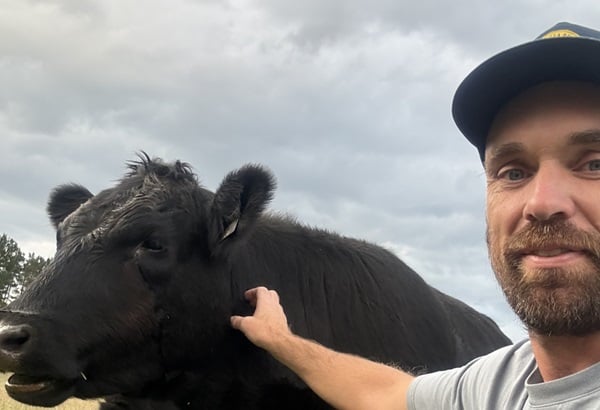
 Producer Jimmy Luscombe is combining grazing management, soil health and whole-carcase use to create more value across the NATIV business. Image supplied.
From healthier soils to stronger cattle performance
When NSW producer Jimmy Luscombe took over his family’s Southern Highlands cattle enterprise following his father’s passing in 2018, he took the time to re-evaluate how they did things.
He soon began shifting the business to a regenerative operation – one that would go on to produce nose-to-tail beef products that provide valuable nutrition to consumers across the nation.
Jimmy’s journey to producing organic grassfed cattle for his co-founded business, NATIV, began several years earlier following a series of major back surgeries in his mid-20s.
Close friend and NATIV co-founder, Jake Campbell, built Jimmy’s rehabilitation program as a holistic exercise coach – centring his recovery on functional health and fitness, and nourishing whole food.
“Organic beef was a key pillar of my recovery nutrition protocol, and taking over the family farm enabled me to become more immersed in that journey from paddock to plate,” Jimmy said.
“It was also a bit of a turning point, where Jake and I realised my beef could play a role on other people’s health journey too.”
Jimmy and Jake collaborated with third generation butcher (and NATIV co-founder) Mat Mauger and worked through an abattoir at Picton, NSW, which did private kills.
They began processing beef from the farm and putting together.
Farm snapshot
-
NameJimmy Luscombe, ‘Mika’s Rest’
-
LocationSutton Forest, NSW
-
Area in hectares208ha
-
EnterpriseBlack Angus and Angus-cross
-
PasturesPhalaris, cocksfoot and rye, with sorghum millet, radish, turnip, crimson clover, plantain and mungbeans
-
SoilsBrown Krasnozems
-
Rainfall800mm
A new opportunity
What began as a small direct-to-consumer venture out of a cold room installed in their local gym soon highlighted another opportunity.
The leftover bones, fat and offal needed a purpose, and Jake happened to have one that not only captured full carcase utilisation, but took their business to the next level.
“Jake is a pretty passionate cook, and at the time he happened to be in pursuit of the perfect beef bone broth,” Jimmy said.
“We rented out the Collaroy Surf Life Saving Club commercial kitchen for Jake to experiment in. Sure enough, he developed some deeply satisfying bone broths that would take NATIV beyond our local gym.”
Taking time to learn a thing or two
On-farm, Jimmy said drought conditions around the time of his father’s passing had forced destocking before he stepped in to manage the enterprise, serving as an opportunity to reassess current grazing land management systems.
“Dad had already been producing organic beef before he passed, but I felt there was value in exploring different systems that might help optimise soil and pasture nutrient density,” he said.
“Our destocked numbers gave me a bit of time to focus on educating myself before I made any management decisions.”
Firstly, he completed a Certificate in Nutrition Farming in Yandina, Queensland, with Graeme Sait, which was heavily focused on soil and plant health, and associated carbon sequestration.
He then did a Farming and Grazing for Profit course with Resource Consulting Services (RCS), looking at:
- finance and business management
- feedbase budgeting
- grazing land management
- improving soil health
- maximising rainfall events.
The new plan on rotation
Armed with new knowledge and insights, Jimmy began making changes to improve his grazing land management and optimise pasture utilisation, yield and quality.
“My dad had already reduced paddock sizes into 4ha grids,” Jimmy said.
“To optimise pasture utilisation, I relocated water troughs to the middle of each paddock and installed a series of automatic spring release fences to create 1ha cells.
“These automatic springs release a new fence each day, enabling my herd to graze on fresh grasses daily for a rotation of approximately 30-38 days in the growing season.
“It’s obviously very labour intensive – as we are physically moving cattle every four days – but we are achieving an optimal rest period that is playing an essential role in keeping our pastures productive year-round.
“When the livestock only have the chance to chew each plant once, we have found it yields the best recovery as it leaves enough solar panel on the leaf to ensure a strong regrowth for the next rotation.”
He said another benefit to these 1ha cells is that it makes stocking rate calculations easier to monitor.
Jimmy said the process is extended during his non-growing season to deliver 70-75 days of rest to each paddock – reducing his stocking rates by 35-50% to allow for the slowed grazing rotation.
Grown from the ground up
Jimmy is a firm believer that all great food starts with good soils.
To better his soil health and nutrition, he began:
- adding prescription blend composts for mineral balance
- introducing dung beetles to increase nutrients and carbon into the root zones of pastures
- sowing in cocktail mix of cover crops to improve soil biology
- regularly using worm castings and worm juice foliar applications to maximise plant health and growth.
“Traditionally, our focus has been on nitrogen, phosphorus and potassium for improved pasture productivity, but there’s so much more happening underground that is also super important to pasture quality and its nutritional value,” he said.
“Introducing dung beetles in particular has been a practical way to support the biology of our soils to deliver healthier and more productive pastures.
“Their tunnelling cycles soil and moves manure into the ground – improving the flow of water, nutrients and carbon into the root zones of pastures.
“Combined with our use of composts and our cocktail cover crop mix of sorghum millet, radish, turnip, crimson clover, plantain and Mungbeans, we have seen a great improvement to our feedbase quality.
“Moreover, we’ve started experiencing longer growing seasons, which have in turn led to better weight gains and animal performance.”
More business for more meats
Beyond the bone broth, Jimmy said NATIV has found additional uses for his left-over fats and offal.
“We completed a research project with MLA in 2024, where we focused on uncovering value-adding opportunities for our beef bone broth,” he said.
“The project helped us determine the ideal ratio of beef bones that would produce a superior amino acid profile. It also helped us realise more functional food options for beef products that targeted health-conscious consumers, and enhanced carcase utilisation.
“We’ve now got beef tallow for cooking, biltong snacks, and supplements made from freeze dried beef spleen, liver, heart, kidney and bovine gelatin – all of which cater to our goal of improved sustainability and full carcase utilisation.”
NATIV has also seen growth in working with other proteins, including lamb, pork and chicken, bringing a whole new range to NATIV Meats.
“Throughout our business journey, we have come into contact with a lot of amazing producers who align heavily with our brand messaging and values,” Jimmy said.
As demand continues to grow, expanding partnerships with like-minded producers remains a priority for the business.
“We're always interested in working with producers who are passionate about regenerative farming and sharing their paddock-to-plate story with consumers,” he said.
“I think a big component behind what makes our meat cuts and beef food products so appealing to consumers is our transparency in relation to our farming practices.
“It allows them to trust us, but more importantly, it allows for the continuous prosperity of our industries.
“We've got some of the best producers and livestock systems in the world, and through NATIV, I'd love to see more of our products reaching consumers both here and eventually overseas.”