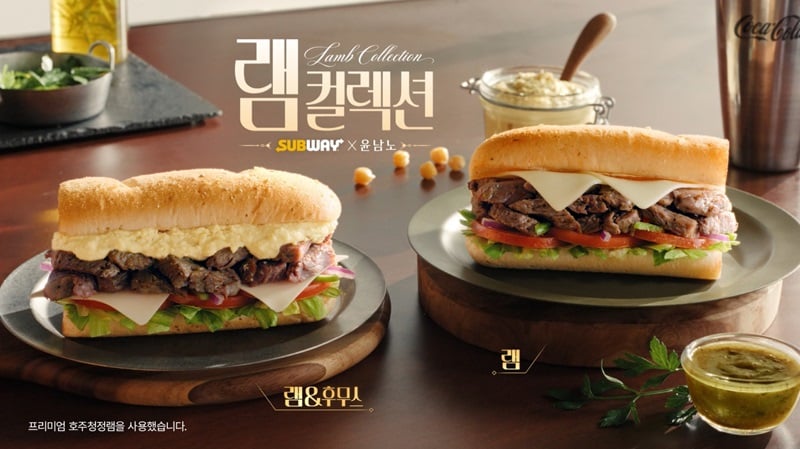
 Subway Korea’s Australian lamb sub introduced the product to new consumers through a familiar, convenient format. Image supplied.
New opportunities for red meat in Japan and Korea
Despite economic uncertainty, tariff challenges and cautious consumer spending, Australian red meat has continued to strengthen its position in Japan and Korean markets, with 2026 proving a year of resilience and growth.
For Travis Brown, Meat & Livestock Australia’s (MLA) Regional Manager - Japan and Korea, the year reinforced the value of long-term investment in market development and consumer engagement.
Australian beef and lamb continued to find new audiences and new eating occasions despite challenging market conditions, helping to sustain demand in two of Australia's most important export destinations.
"Resilience is the word that comes to mind," Travis said.
That resilience is best illustrated in Korea's beef market. After setting a record for Australian beef exports in 2025, Korea has already surpassed that mark with two months of 2026 remaining.
The achievement was significant given the hurdles faced throughout the year, including Korea reaching its Australian beef safeguard quota in July, which triggered a higher tariff rate for the remainder of the year.
Despite those conditions, demand has remained strong.
"We've seen a really positive response, with continuing demand for Australian beef from consumers and customers," Travis said.
Japan's story has been slightly different, but no less encouraging. While the market has faced softer consumer spending and increased price sensitivity, Australian beef shipments have largely held their ground.
"To be tracking close to last year is a pretty strong performance given some of the concerns in the market," Travis said.
Those concerns range from global geopolitical instability and higher input costs to supply chain pressures, all factors that can weigh heavily on Japanese buying behaviour.
Yet Australian red meat has continued to perform, supported by decades of investment in building trust, consistency and brand equity.
Australia currently commands more than half of the imported beef market in both countries, a position Travis believed created significant opportunities.
"It's not just about growing our share. As category leaders, we need to grow the category itself," he said.
Creating new reasons to choose red meat
A category growth strategy has been a defining feature of MLA's work across both markets.
Rather than focusing solely on traditional consumption occasions, the team has been looking for ways to introduce Australian beef and lamb into new settings, cuisines and consumer moments.
One standout example has been MLA's Father's Day campaign in Japan.
Now in its third year, the campaign has transformed Father's Day into a meaningful retail occasion for beef sales. Participation has more than doubled, growing from 1,300 stores in 2025 to more than 3,000 outlets nationwide.
The results reached beyond Australian beef sales alone.
"The chains that executed the program well achieved really strong growth," Travis said.
Not only did Australian beef sales increase, but participating retailers saw growth across their total beef category to create a win-win outcome for both MLA and its retail partners.
In Korea, the team has focused on tapping into the rapidly growing institutional catering sector, which includes schools, hospitals and large corporate cafeterias.
Through MLA's Aussie Meat Academy program, nutritionists and menu planners were introduced to new ways of utilising lamb in their operations.
Of the 148 attendees at one recent workshop, more than 100 reported they had never previously used lamb in menu planning but planned to do so in the future as a result of the workshop.
One of Korea's largest conglomerates, GS Group, trialled lamb dishes across its employee cafeterias, serving up to 2,000 meals daily.
Feedback was overwhelmingly positive and lamb has since secured a permanent place on the menu rotation.
The trial has introduced lamb to thousands of consumers who may not have previously considered it.
"We've got 1,500 to 2,000 people who probably weren't eating a lot of lamb previously," Travis said.
"Now they're getting exposed to it and enjoying it every three weeks."
Australian lamb has traditionally been associated with Korean barbecue.
Expanding consumption into cafeterias, lunch menus and everyday dining occasions has helped normalise lamb as a versatile everyday protein rather than a niche choice.
A Subway partnership delivering results
The year’s most unexpected example of category expansion can be found between two slices of bread.
Following months of engagement with Subway Korea, MLA helped facilitate the launch of a nationwide Australian lamb sub promotion across nearly 600 stores.
The collaboration emerged after Subway's marketing and menu development teams participated in an Aussie Meat Academy session featuring celebrity chef Namno Yoon, a major media personality in Korea following his recent Netflix appearances.
MLA initially expected Subway to pursue Australian beef options, but the company instead identified a unique opportunity with lamb.
The result exceeded expectations.
Within just two weeks of launch, more than 200,000 lamb subs were sold, exceeding Subway's sales targets by 70%.
"It has outperformed all of their expectations," Travis said.
The promotion also delivered a significant branding benefit.
Backed by Subway’s multi-million-dollar advertising campaign spanning television, billboards, digital media and in-store promotion, millions of Korean consumers have been exposed to a tagline promoting ‘premium Australian lamb’.
For MLA, the campaign demonstrated the power of introducing lamb in new formats that challenged traditional consumption habits.
"It's given us a great opportunity for trial, exposure and enjoyment," Travis said.
Building momentum into 2027
While 2026 delivered plenty of positives, Travis believes some of the strongest opportunities may still lie ahead.
Several major beef partnerships are currently nearing fruition, including a large Japanese foodservice operator preparing to switch a major steak program from US beef to Australian beef.
Another nationwide Japanese chain is expected to launch a 100% Australian beef burger early next year.
The Year of the Sheep, which will coincide with Lunar New Year celebrations in 2027, also presents a unique opportunity to further elevate lamb consumption across Asia.
Travis said the goal is simple - use culturally significant moments to encourage trial and convert occasional consumers into regular buyers.
"We hope a few more people are exposed to lamb, become a little bit more familiar with it and stay in the category," Travis said.
Successful initiatives such as Father's Day in Japan, institutional catering programs in Korea and the hugely popular Chago's Table digital series will continue to evolve.
Now in its third year, Chago's Table has grown from attracting around one million views per episode to more than four million, giving MLA an increasingly powerful platform to share the story of Australian beef with Korean consumers.
Taken together, the achievements of 2026 point to a broader lesson.
In mature markets facing economic pressure and shifting consumer behaviour, growth doesn't always come from selling more of the same product to the same people.
Often, it comes from creating entirely new opportunities to enjoy it. For Travis and the Japan and Korea team, that's exactly where the focus remains.