Heavier carcases reshape September-quarter production
Key points
- Beef production reached 774,986 tonnes, the highest September quarter in the series since 1972.
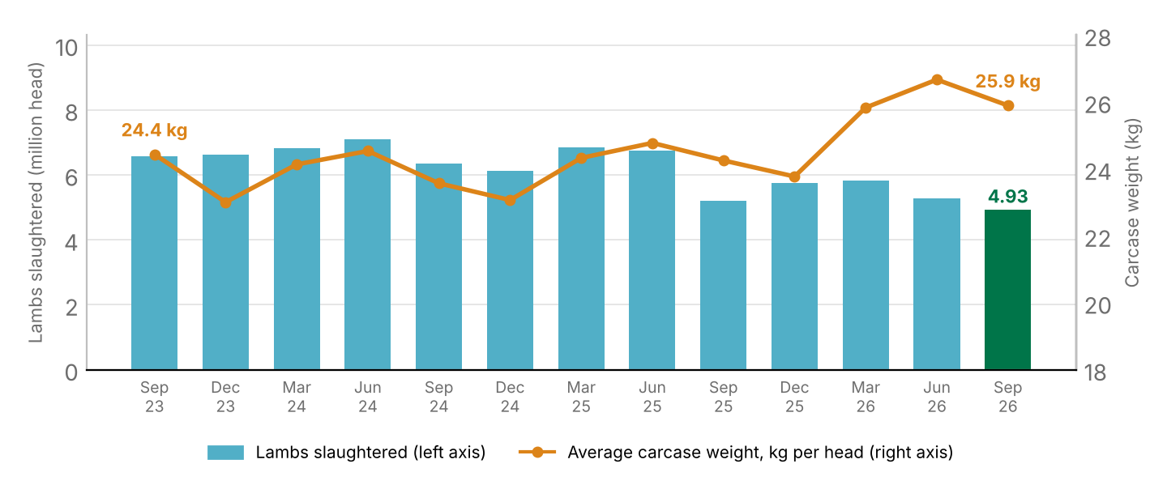
- Lamb slaughter fell to 4.93 million head, the lowest since the June quarter 2020. However, carcases were 6.8% heavier.
- Sheep slaughter dropped 33.3% year-on-year, the third-lowest September quarter in the series.
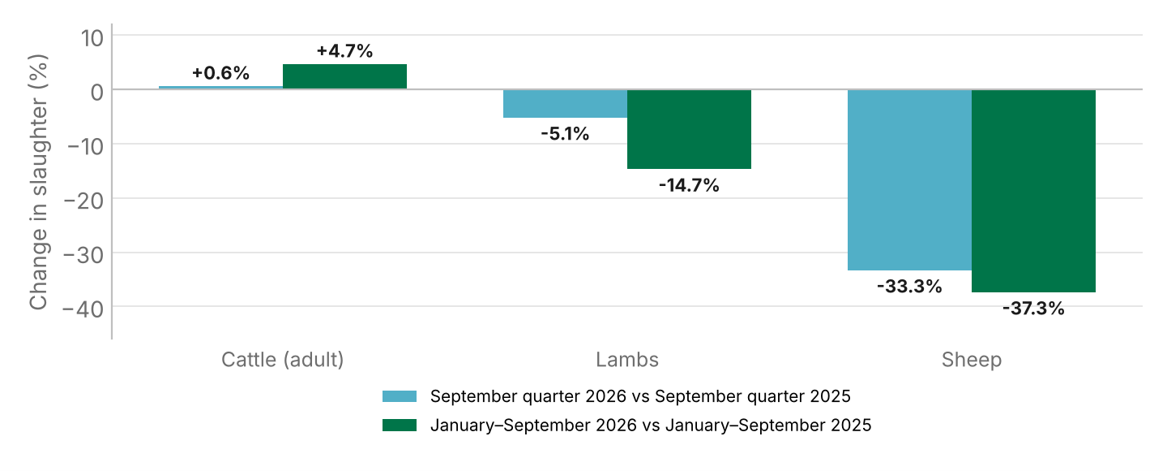
The Australian Bureau of Statistics (ABS) Livestock Products data showed 2.49 million adult cattle, 4.93 million lambs and 1.34 million sheep were slaughtered in the latest July to September quarter.
Over the first nine months of the 2026 calendar year, cattle slaughter was 4.7% higher than in 2025, lamb slaughter was 14.7% lower and sheep slaughter was 37.3% lower.
Heavier carcases were the common thread, with average weights above year-earlier levels for all three species.
Year-on-year change in slaughter, September quarter 2026 and January–September 2026, by species
Source: ABS.
Beef production reaches a September-quarter high
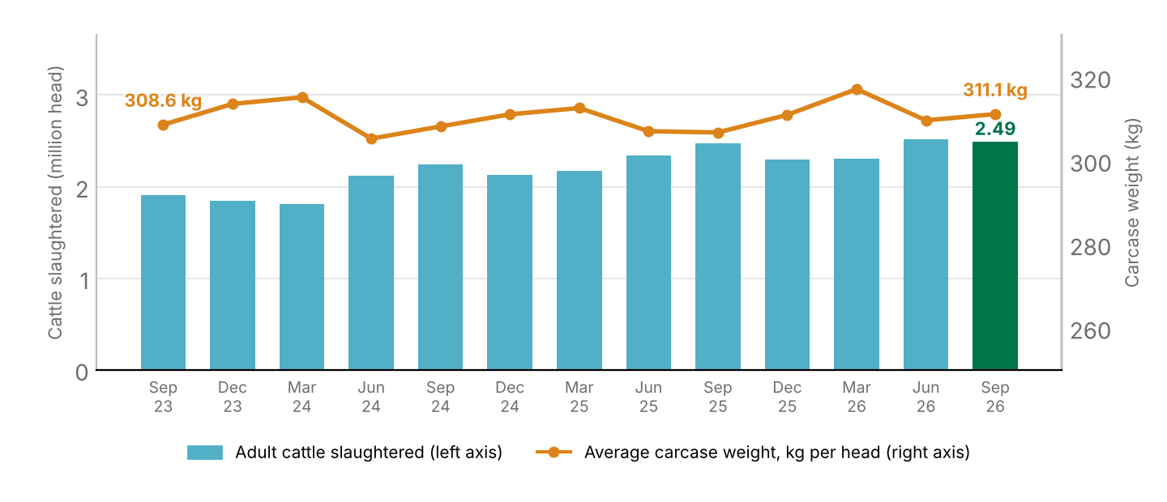
Adult cattle slaughter was 0.6% above the September quarter last year, but 1.2% below the June quarter.
Steers, bullocks and bulls totalled 1.21 million head, up 4.5% year-on-year and the highest quarterly kill since the March quarter recorded in 1979. Cow and heifer slaughter eased 2.8% to 1.28 million head.
Adult cattle slaughter and average carcase weight
Source: ABS
As a result, the female slaughter rate fell to 51.2% from 55.0% in the June quarter. This follows the annual pattern of females peaking in the June quarter and easing in the September quarter.
Queensland slaughter increased by 6.3% to 1.14 million head, or 45.9% of the national kill. Slaughter was lower in NSW, Victoria, SA, WA and Tasmania, ranging from a 2.6% decrease in Victoria to 7.8% in Tasmania.
Average carcase weight rose 1.4% to 311 kilograms, lifting beef production 2.1% above the same quarter metrics as the previous year. The June quarter at 780,525 tonnes is the only quarter to have recorded a higher volume.
Year-to-date, cattle slaughter of 7.31 million head was the third-highest January to September total in the series, behind the 1977 and 1978 records.
Beef production of 2.29 million tonnes, up 6.0%, was the highest for the period in the series.
Lamb slaughter eases to its lowest since 2020
Lamb slaughter totalled 4.93 million head, 5.1% below the September 2025 quarter last year and 6.7% below the June quarter.
Source: ABS
Average carcase weight reached 25.9 kilograms, 6.8% higher year on year. This supported production of 127,791 tonnes, 1.3% above the same quarter last year. The June quarter's 26.7-kilogram average carcase weight remains the highest in the series.
Victoria (2.63 million head) and NSW (1.23 million head) accounted for more than three-quarters of the kill, and both were more than 7% lower year-on-year. In contrast, slaughter rose 5.6% in WA and 17.6% in Tasmania.
Year-to-date, lamb slaughter totalled 16.05 million head, down 14.7% from 2025 while lamb meat production fell 8.9% to 419,354 tonnes.
Sheep slaughter drops by one-third
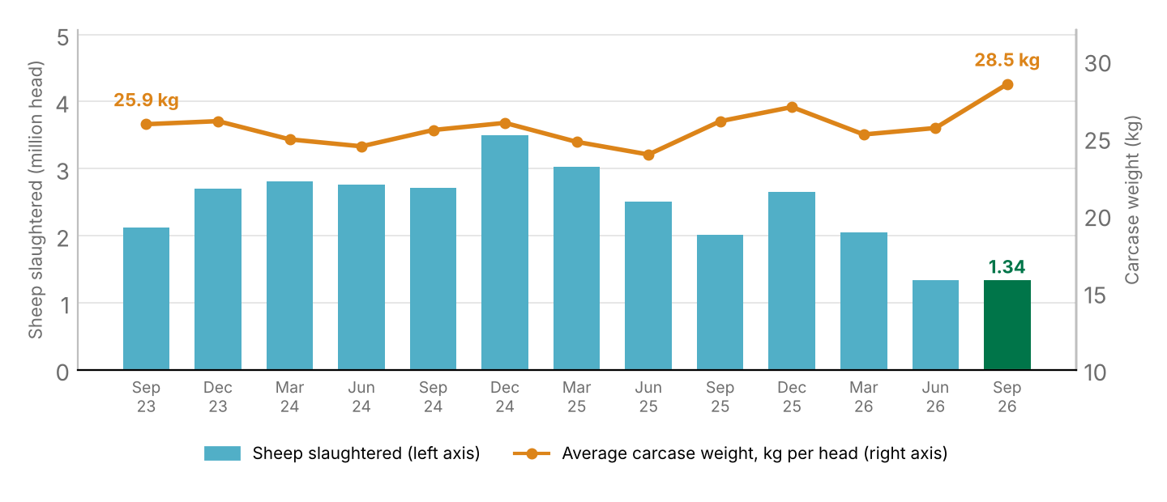
Sheep slaughter recorded a 33.3% decline on last year and was the third-lowest September-quarter kill in the series, behind 2011 and 2020. It was the sixth consecutive quarter of year-on-year decline.
Sheep slaughter and average carcase weight
Source: ABS
NSW slaughter fell 45.0% to 407,900 head, while Victoria and WA each fell 28.7%. Tasmania was the exception among the major states, up 18.6%.
Mutton production fell 27.1% year-on-year to 38,132 tonnes, the lowest September-quarter total since 2021. Average carcase weight reached 28.5 kilograms, up 9.2% from a year earlier and the highest in the series.
Year-to-date, sheep slaughter fell 37.3% to 4.72 million head, while mutton production declined 33.7% to 124,060 tonnes.
Together, the data indicates cattle supply holding firm, supported by higher throughput volumes and heavier carcases, while sheep and lamb supply continue to contract.