Feedlots fill as grainfed turn-off reaches a record
Key points
- Feedlots turned off a record 3.12 million head in the first nine months of 2026, up 15% year-on-year.
- Feedlot turn-off was equivalent to 42.7% of adult cattle slaughter, up from 38.9% in the same period of 2025.
- Feedlots are 91.5% full nationally, with NSW accounting for two-thirds of the growth in feedlot capacity over the past year.
Feedlot capacity continues to expand with grainfed cattle accounting for a growing share of Australia’s beef supply as total cattle slaughter reaches its highest level since 1978.
Feedlot turn-off rose 15% (408,624 head) year-on-year to a record 3.12 million head in the first nine months of 2026, according to the Australian Lot Feeders’ Association (ALFA) and Meat & Livestock Australia (MLA) National Accredited Feedlot Survey.
Over the same period, adult cattle slaughter rose 4.7% to 7.31 million head, according to the Australian Bureau of Statistics (ABS).
The increase in feedlot turn-off exceeded the rise in adult cattle slaughter, which suggests grainfed cattle accounted for all this year’s growth in national throughput, while non-grainfed cattle slaughter declined year-on-year.
More of the throughput increase is coming off grain
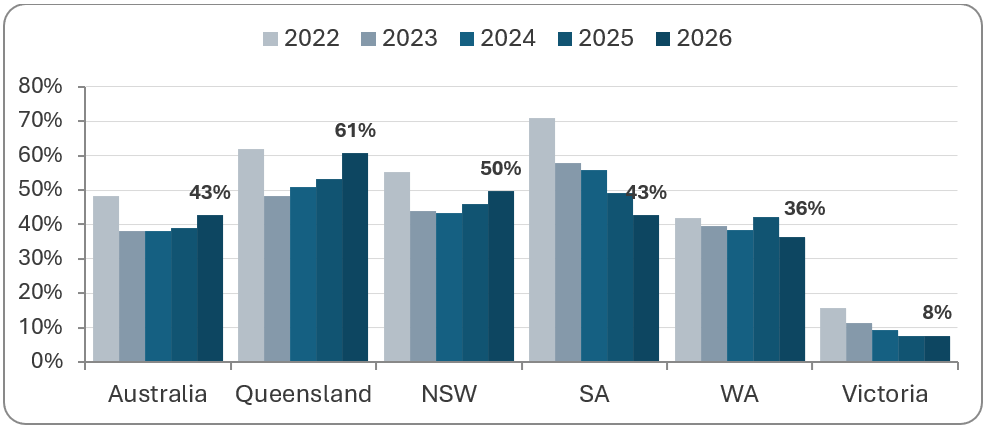
Feedlot turn-off was equivalent to 42.7% of adult cattle slaughter in the first nine months of 2026, up from 38.9% a year earlier and the highest share for the period since 2022.
This reflects strong international demand for grainfed beef in the first half of the year and the impact of seasonal conditions on grassfed production in parts of Queensland and NSW.
The 2022 share was higher at 48.4%, but it came from a much smaller throughput of 4.39 million head.
Growth slowed in the September 2026 quarter. Total slaughter rose just 0.6% year-on-year to 2.49 million head, while feedlot turn-off rose 6.6% to 1,026,366 head, equivalent to 41.2% of adult cattle slaughter.
Feedlots have provided a steady flow of cattle to processors through the year, helping to underpin the strong throughput recorded in 2026.
The two biggest feeding states led the way in the September quarter.
In Queensland, feedlot turn-off was equivalent to 56.4% of adult cattle slaughter, up from 52.6% a year earlier. In NSW, the share rose to 50.7% from 48.4%, while it eased in SA and WA.
Feedlot turn-off as a share of adult cattle slaughter by state, January - September 2022–2026.
Source: ALFA.
NSW leads the push for more pen space
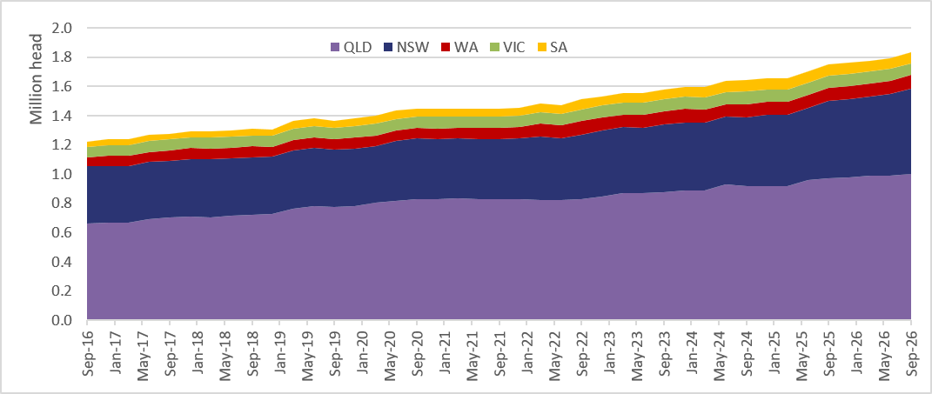
Feedlot capacity continued to expand, reaching a record 1.834 million head in the September quarter, 4.9% more than a year earlier.
NSW accounted for around two-thirds of the additional capacity over the past year.
Feedlot capacity by state
Source: ALFA.
Queensland remains the backbone of the sector, with close to 1 million head of capacity, more than half the national total.
However, NSW capacity has grown faster, lifting its share of the national total from 29% to 32% over the past five years.
Demand for that space remains strong with national utilisation at 91.5%. Queensland feedlots are operating close to full at 97.5%, leaving little room for more cattle without further investment.
Together, record turn-off, longer feeding and growing pen space mean grainfed cattle are supplying a larger share of Australia’s beef, with NSW increasingly setting the pace.
Record feedlot turn-off and expanding capacity are changing how cattle move through Australia’s production system.
MLA’s November Beef Producer Intentions Survey provides producers with an opportunity to share how seasonal conditions and market signals are influencing their own herd and turn-off decisions.