Why restockers are favouring steers this spring
Key points
- Increased spring supply placed downward pressure on young cattle prices.
- Restocker demand is favouring steers over heifers.
- Lower yardings and renewed rainfall supported a recovery in October.
The spring increase in cattle supply has created a clear divide in the Australian cattle market with buyer demand increasingly determining which cattle are holding their value.
National cattle numbers contributing to the indicators increased 52% over four weeks to late September, coinciding with a sharp correction in young cattle prices.
NSW recorded the largest increase in supply as dry spring conditions reduced the incentive for some producers to retain lighter cattle for further weight gain.
However, the pressure has not been evenly distributed. Restocker heifers have recorded the steepest price falls, while demand for restocker steers and heavier cattle has remained considerably stronger.
Restockers favour steers
The National Restocker Yearling Heifer Indicator fell 20% from 477¢/kg liveweight (lwt) on 8 September to 384¢/kg lwt on 28 September. The Restocker Yearling Steer Indicator declined 10% over the same period.
The widening price spreads provide a clearer indication of where restocker demand is concentrated.
On 8 October, restocker steers traded at 34¢/kg more than feeder steers and were well above the 12-month average premium of approximately 8¢/kg.
A premium of this size is relatively uncommon. Over the past 12 months, the restocker steer premium has exceeded 34¢/kg on only around 6% of trading days.
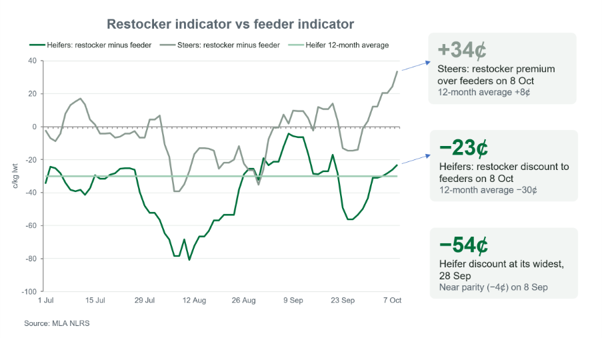
The difference between sexes is even more pronounced.
Restocker steers are currently around 104¢/kg above restocker heifers, compared with a 12-month average premium of 88¢/kg. In contrast, feeder steers are 47¢/kg above feeder heifers, broadly in line with the longer-term price relationship.
This suggests lot feeders are continuing to price heifers relative to steers much as they normally would.
The larger adjustment has come from restockers who are competing strongly for steers, while remaining more cautious about purchasing females.
Lighter heifers requiring a longer carrying period remain particularly exposed to seasonal risk, while steers and heavier, feed-ready cattle are attracting stronger competition.
Supply eases and prices respond
The market has begun to recover as cattle numbers have declined and rainfall has reached parts of southern Australia.
National indicator cattle numbers fell to 20,766 in the week ending 8 October, around half the late-September peak of 40,558 head. However, public holidays in NSW and Queensland contributed to the decline.
Since reaching their September lows, restocker heifer and steer prices have recovered 8.5% and 8.4% respectively.
Queensland has led the recovery, supported by fewer cattle and renewed interstate buying.
At Dalby saleyard this week, supply fell by 1,300 head, while medium and heavy yearling steers and heavier feeder heifers recorded stronger prices.
The next test will be whether the recovery can be sustained. Rainfall and feed availability remain central to buyer confidence, particularly for females.
Until seasonal confidence strengthens, the current market is likely to continue favouring cattle that can be finished or turned off sooner.
Attribute content to: Emiliano Diaz, MLA Senior Market Information Analyst
Information is correct at time of publication on 9 October 2026