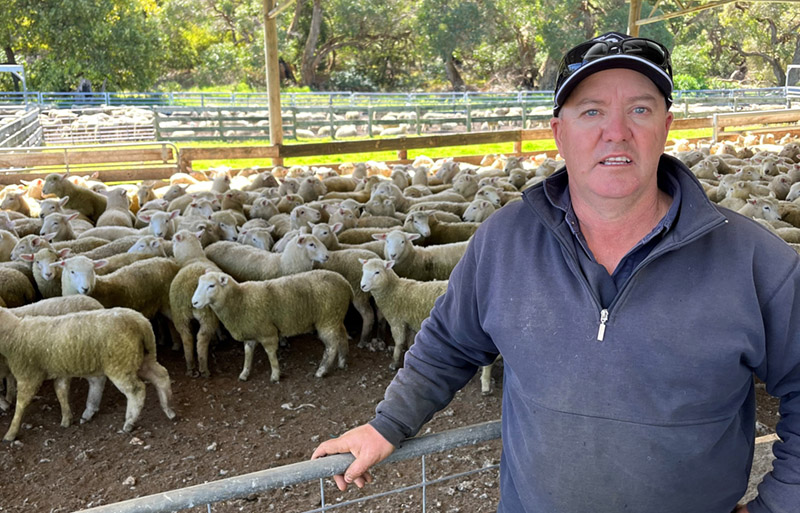
 SA sheep producer Richie Kirkland.
The management shift delivering measurable results
Improving reproductive performance was a key driver behind Richie and Nikki Kirkland’s decision nearly a decade ago to adopt electronic identification (eID) technology in their prime lamb enterprise in SA’s Lower South East.
The system has contributed to a 15% increase in lambing rates with this stronger performance backed by more twin-bearing ewes and fewer dry ewes.
Rather than collecting data for its own sake, Richie said the focus has been on using information in practical ways to improve management decisions.
On-farm snapshot
-
NameRichie and Nikki Kirkland and family
-
Location‘Kirklands’, Furner, SA
-
Area in hectares2,500ha
-
EnterprisePredominantly prime lamb enterprise running 9,000 maternal composite ewes and 2,000 ewe lambs, plus cropping
-
PasturesPhalaris, annual ryegrass, sub-clovers and balansa clover
-
SoilsVariable – black flats through to sandy rises
-
Rainfall600 mm
Business management
The Kirkland family has been farming at Furner since moving to the district through the soldier settlement scheme in the 1950s. Their 2,500ha property ‘Kirklands’ is now managed by Richie and Nikki and their two children.
As well as their flock, the Kirklands crop about 700ha of broad beans, wheat, barley and canola, of which about 20% is retained on farm for feed.
Paddock sizes range from 30-50 ha and are serviced by laneways.
Sheep are run in large mobs of 800–2,000 for most of the year with mob size being reduced to as low as 50 during lambing for ewes with multiples.
Grown ewes are mated from January with scanning in March. Dry ewes are rejoined soon after, along with ewe lambs, and are scanned a second time in May. Any remaining dries are sold.
The Kirklands introduced eID in 2017 as part of a broader focus on improving reproductive performance, lamb growth and feed efficiency in their flock of 9,000 maternal composite ewes.
Their goals were to:
- Improve reproductive efficiency
- Keep track of ewe lambs born as twins
- Ensure more efficient use of available feed for ewes
- Identify best performing paddocks for lambing
- Achieve fast growth rates in lambs
- Enable easier animal handling
- Streamline how they record stock movements.
To achieve these improvements, the Kirklands collect individual animal data including pregnancy scanning results (triplets/twins/singles/dry), condition score, lamb weights and marking and weaning (as well as opportunistically at other times), birthing difficulties and paddock of birth.
|
Seasonal action plan
|
The right data for the job
The Kirklands selected their eID equipment based on its capability for data collection and lifetime storage capacity (up to 100 pieces of information for each animal).
Their decisions were also informed by speaking to other producers, and their own experiences with eID equipment.
They use:
- A Tru-Test XR5000 weigh scale indicator integrated with a Te Pari HD3 autodrafter/ handler based at the main yards
- A wand reader to collect data in the paddock – for example, with ewes displaying health concerns
- A custom-made portable race reader unit, which incorporates a Tru-Test XRP2 eID reader with twin panel antennas, in satellite yards.
They currently use data from the indicator to guide real-time drafting decisions based on weight, birth status or pregnancy status.
Looking ahead, the Kirklands would like to learn to use more of the features available within the indicator to guide drafting based on multiple attributes to differentiate higher and lower performing individuals.
However, at present, data is not managed with excel or other data management software away from the drafting race. Limited data is also uploaded onto livestock management software, AgriWebb, to keep track of where stock are located.
Richie said the factors limiting more complex data management are time, cost and availability of producer-friendly software that can link to apps currently used on farm like AgriWebb and Lambplanner.
The Kirklands use eID to help support management decisions to improve their flock productivity. Image supplied.
Turning data into decisions
This technology is helping the Kirklands achieve their livestock goals, through targeted flock management.
They use pregnancy data to maximise retention of ewes born as twins and twin bearing ewes, as well as to identify twice-dry ewes which are removed from the flock. This has contributed to an overall 15% improvement in lambing percentage over the past several years.
The Kirklands use pregnancy scanning data to split ewes into management groups based on lambing status (single/multiple).
This supports more targeted feeding and improved feed allocation across the flock. Smaller mob sizes for multiple-bearing ewes have helped improve lamb survival and reduce the risk of mismothering.
Richie believes these increases in reproduction could have been greater if they had not also been pursuing the expansion of their overall flock size during that time. The Kirklands began tagging ewe lambs with eID in 2017.
This technology is helping the Kirklands achieve their livestock goals, through targeted flock management. The desire to increase overall numbers of stock being run has led them to retain more single bearing ewes than they otherwise would have.
Despite this reduced ability to apply increased selection pressure for twinning, the number of ewes bearing twins has risen from about 50% 10 years ago to 75%.
One challenge has been balancing the reduced early growth rates of twins against higher target turnoff weights (which have increased from 20–22kg to 24–26kg in recent years).
To achieve these processor specifications, the Kirklands weigh lambs as frequently as possible to monitor performance. This also provides insights around ewe performance and nutrition or health factors which could be impacting performance.
The Kirklands also collect data on:
- Condition score – to guide nutrition decisions in the lead-up to joining and during pregnancy, and to identify high performing ewes that rear twins with good weight gain and recover condition score quickly ahead of the subsequent joining.
- Paddock performance – to inform allocation of lambing paddocks based on the success of ewes in birthing/rearing lambs on a paddock-by-paddock basis.
|
Lessons learned
|
Looking ahead
Future plans for the Kirklands include tracking ram performance for reproductive efficiency and lamb growth rates and developing lifetime performance records for ewes to support more informed breeding and culling decisions.
They are also interested in using software to combine multiple traits, including reproduction, growth and condition score, to help rank animals and support selection decisions.
Collecting health related data, such as dag score and worm egg counts, is another goal.
Down the track, they plan on investing in an in-paddock weighing system to streamline the process of collecting average daily weight gain data.
This case study was developed as an initiative of eID Advantage Program from the Government of South Australia, supported by MLA and AWI Extension SA.