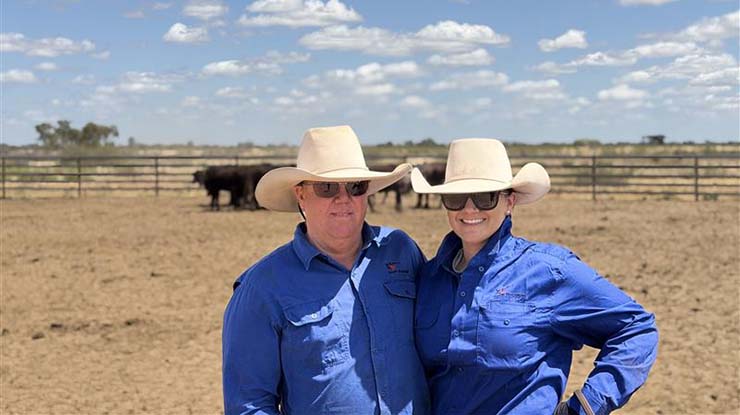
 Senku Wagyu producers Adam and Hayley Rea at Torrens Creek, Queensland where a focus on genetics and production excellence helps deliver a premium Wagyu product. Image supplied.
The Australian Wagyu fillet that beat the world
A first-time entry, a 5am text message and a steak that rewrote the history books.
Paradigm Foods’ Senku Wagyu has been crowned the world’s best steak at the recent World Steak Challenge.
The win, on 10 September, puts another Australian product on top of the global podium and highlights the strength of the nation’s premium beef supply chain.
When Nick Thompson’s phone lit up at 5am with a congratulatory text message, confusion soon became celebration.
The General Manager of Paradigm Foods knew the World Steak Challenge awards ceremony was taking place in Amsterdam, but the message gave little away.
Within minutes more notifications started arriving and the significance became clear.
Paradigm Foods had not only won a category – it had been awarded the best steak in the world.
“It was a huge shock,” Nick said. “Just because of actually how big this event is becoming.”
A year of firsts
The result was remarkable for several reasons.
It was Paradigm’s first year entering the competition, and the winning cut was a Wagyu tenderloin, the first eye fillet to ever take the overall title in the competition’s 11-year history.
Traditionally, striploins and rib eyes have dominated the awards. Tenderloins are prized for tenderness, but are often considered less flavourful than harder-working muscles.
For Nick, however, the result reflected the unique qualities of the Senku purebred Wagyu program.
“Our purebred tenderloins are an amazing product,” he said.
“Everyone believes that an eye fillet is always tender, but it often lacking in flavour.
“I actually had some of this particular eye fillet on the Friday after we realised it had won. It was an outstanding piece of meat.”
The winning tenderloin came from a marble score 9+ purebred Wagyu animal and selected alongside striploins and cube rolls from the same carcase specifically for the competition.
Bred for victory
While the marbling was important, Nick believed the victory was years in the making.
“It starts right back at the farm and the breeding,” he said.
Nick said Australia’s purebred Wagyu story was becoming one of the country’s unique competitive advantages.
While Wagyu genetics originated in Japan, Australia had spent more than three decades developing animals suited to local conditions that maintained exceptional eating quality.
The result is a distinctly Australian purebred Wagyu sector that continues to evolve.
“The purebred program is something Australia can actually hold title to and claim,” Nick said.
“These purebred animals are starting to become really unique to Australia.”
The Senku brand itself takes its name from the Japanese word for ‘pioneer’.
It acknowledges the producers who first introduced Wagyu genetics to Australia and laid the foundation for today’s industry.
Many of those pioneering bloodlines remain central to the program today.
“Some of the guys we’re working with are some of the original people that bought Wagyu cattle out from Japan,” Nick said.
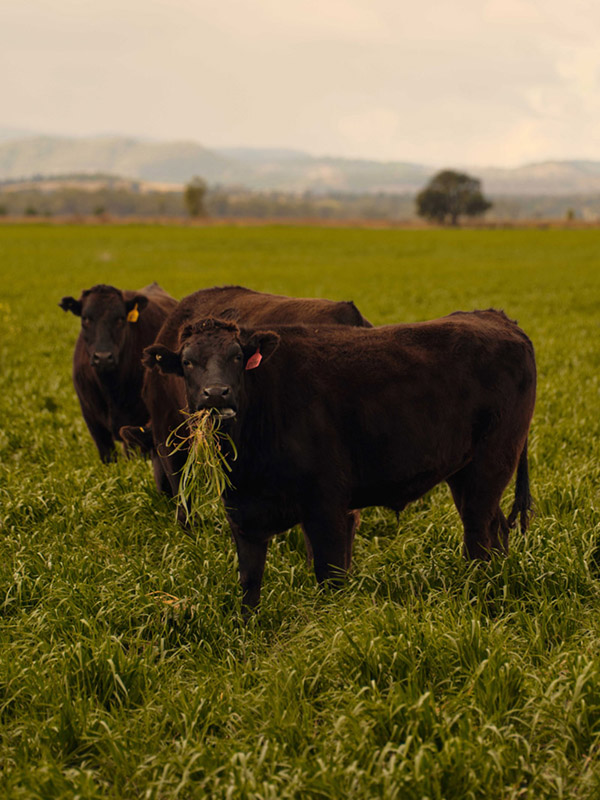
Senku Wagyu cattle bred and raised to deliver the consistent quality consumers expect from the premium beef brand. Image supplied.
Relationships matter
Beyond genetics, Nick pointed to the role of long-term supply chain partnerships.
Paradigm Foods has worked with Smithfield Cattle Company and its Sapphire Feedlot for the past eight years.
Together, they have refined feeding programs to consistently deliver the desired carcase and eating quality outcomes.
“I believe it’s the genetics of an animal which help control the quality,” he said.
“I really do think that the feeding of an animal helps dictate the flavour.”
The focus on outcomes rather than inputs extends to Nick’s thinking on feeding days – a metric often used as shorthand for quality in premium beef programs.
While the winning cattle were fed for more than 430 days, he argued the industry should be moving away from promoting feeding periods and instead focus on the final result.
“I’m actually one person that doesn’t like telling the number of days that an animal has been fed,” he said.
“I think we as an industry need to move towards hitting a carcase type and a carcase specification, irrespective of the number of days that it takes to get there.”
For Nick, the ultimate goal was to produce consistent eating quality through an integrated supply chain that spanned breeding, backgrounding and feedlotting.
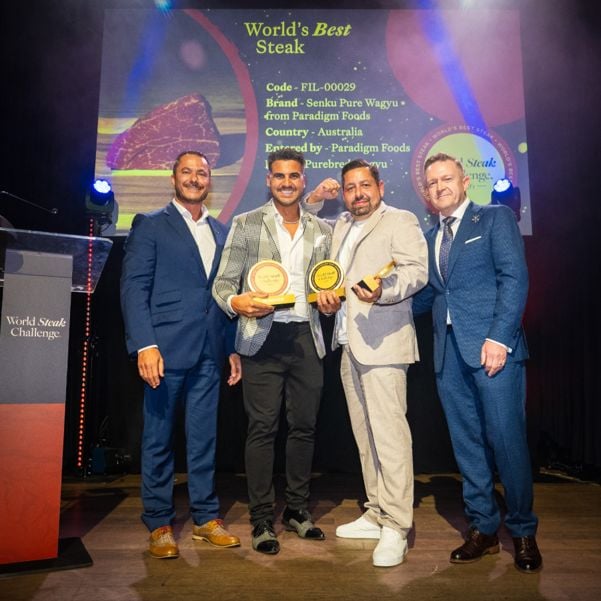
Ioannis Gammenos, Co-Chief of World Steak Challenge and Head Chef Heliot Steakhouse, London, Rayco Espantoso – Las Manas, Antwerp, Kiarash Nabavieh – Wagyu District Antwerp, Richie Wlison, Co-Chief of World Steak Challenge and Culinary Director at Sole Seafood & Grill. Image supplied.
Australia’s place on world stage
The World Steak Challenge result also reinforced a broader trend. Australian beef had become a dominant force on the global stage and claimed multiple titles over the competition’s history.
Nick believed Australia’s success stemmed from a willingness to understand consumer preferences and build production systems around them.
“We understand what global customers want,” he said.
“We’ve really worked to develop a supply chain and a production system that matches that.”
Compared with Japanese Wagyu, which some consumers now view as exceptionally rich, Australian Wagyu occupies an increasingly attractive middle ground.
It delivers intense marbling while remaining suitable for larger steak portions and broader dining occasions.
Differences in feeding systems helped Australian beef to stand apart from competitors such as the United States.
“Australian product is actually amazing,” Nick said.
“And it is because of how it performs on the plate.”
While the award had generated significant interest from customers around the world, Nick was quick to emphasise that broader opportunities extended beyond one company.
“This isn’t just a win for us,” he said.
“This is a win for the Australian industry.”
Trade landscape
The timing comes amid a challenging export period.
Trade quotas, tariffs, shifting regulations and geopolitical uncertainty have created headwinds across major export markets, making long-term planning increasingly difficult.
“Our supply chain, from the time we make a breeding decision, to the time we get that meat on a plate, it’s at least four years,” Nick said.
“We’re trying to make decisions today which are really coming out towards 2030.”
Despite the challenges, he remained bullish about the future of Australian premium beef.
As consumers increasingly spend money on memorable experiences rather than products alone, Nick saw an opportunity for Australian Wagyu to continue commanding a place at the world’s best dining tables.
“At the end of the day, we need to deliver experiences for our consumers,” he said.
“People are saving money to spend on experiences.
“Whether that’s seeing the Super Bowl or having the best steak at one of the best restaurants.”
For a moment, Paradigm Foods paused to celebrate the achievement. However, its focus had already turned to what comes next.
“Winning awards for us isn’t the be all and end all,” Nick said.
“We’ve got to keep improving. We’ve got to keep improving our products and keep delivering these experiences for our customers.”
The world’s best steak may now carry the Senku name, but for Nick, the real story was bigger than a trophy.
It is about decades of breeding, feeding, innovation and collaboration that continue to strengthen Australia’s reputation as a producer of world-leading beef.