Developing producer capability in tactical and strategic feed budgeting
Case study: Longford Red Meat Group, Tasmania
Project context
The ‘Improving lamb survival on leguminous pasture’ Producer Demonstration Site (PDS) is a four-year project driven by the Longford Red Meat Group in Tasmania. This project is demonstrating different feedbase and grazing management strategies and their link to lamb mortality.
The feed budgeting process
A key objective of this PDS is to upskill producers to make tactical and strategic decisions throughout the lamb growing season. This includes matching animal demand with feed supply.
At the beginning of the demonstration period, producers took baseline soil tests, feed quality tests and calculated feed on offer (FOO). The results formed the opening feed budget and incorporated any potential nutritional deficits.
Throughout the lamb finishing season (December to June), feed quality tests provided further nutritional composition data, and weekly monitoring of the pasture growth rates ensured feed was accurately allocated to livestock. Lamb liveweights were recorded every three to four weeks to capture liveweight gain and provide context to update the feed budgets.
Over two seasons regularly updated feed budgets provided a valuable decision-support tool by combining current feed availability, projected pasture growth, and livestock feed demand. This enabled timely adjustments to stock numbers in response to seasonal conditions, ensuring feed demand remained aligned with feed supply throughout the season. By regularly monitoring feed availability and forecasting future supply, the farm was able to avoid both large feed surpluses, which can reduce pasture quality and utilisation, and feed deficits, which can compromise animal performance and increase supplementary feeding requirements.
The process improved producer confidence in stocking decisions and allowed the business to capitalise on periods of high pasture availability by carrying more stock when conditions permitted, while also identifying when stock numbers needed to be reduced. As a result, the project demonstrated the value of regularly updating feed budgets to align key seasonal changes with animal numbers and maximise the utilisation of available feed resources.
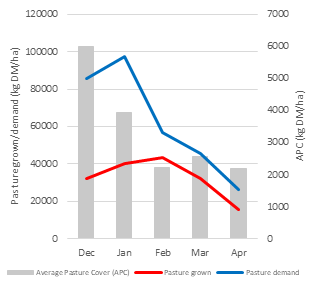
Figure 1. High feed availability in December (bars) supported increased stocking rates, resulting in higher feed demand (blue line) relative to predicted pasture growth (red line).
‘Chester’ – Year 1
At ‘Chester’, one of the PDS sites, in Year 1, the initial feed budget identified a significant surplus of available feed (Figure 1), which allowed the farm to stock substantially more animals than would normally be carried. Under typical seasonal conditions, stocking rates would generally average around 35 head/ha. However, at the start of December, a total of 2,626 lambs were stocked across the 52ha pivot area, equating to approximately 50 head/ha. This represented a 44% increase over the normal stocking rate and was achieved through identifying and utilising the available feed resource.
During Year 1, a total of 2,341 lambs were sold, equivalent to 45 head/ha. The remaining lambs, which were used to crash graze the high feed availability at the commencement of the trial, were moved to another part of the farm and did not continue within the study.
‘Chester’ – Year 2
In Year 2, monitoring and feed budgeting continued and provided the basis for again increasing stocking numbers across the PDS site. During Year 2, a total of 3,390 lambs entered the system, with 2,548 lambs sold as of 18 February 2026.
The ongoing use of feed budgeting enabled stocking decisions to be made with confidence, ensuring animal demand remained aligned with feed availability throughout the season. Across the period from December to May, the average daily feed requirement was approximately 69kg DM/ha/day.
This demonstrates the role of regular pasture monitoring and feed budgeting in supporting higher stocking rates while maintaining an appropriate balance between feed supply and animal demand across the PDS site.
Host producer testimony
“Completing the feed budgets gave me the confidence to make proactive stocking decisions rather than relying on gut feel. Understanding our feed demand versus supply helped us adjust stocking rates at the right time and maintain lamb growth targets.” – Andrew Archer
Advice for producers
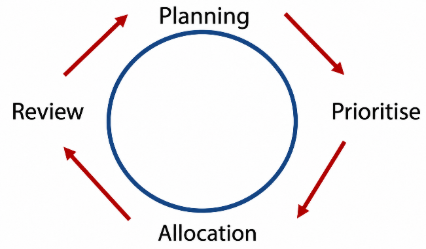
The continuous cycle of planning, prioritising, allocation and review is essential for matching animal numbers to seasonal feed availability. Regular feed budgeting and monitoring enable informed management decisions, helping maximise feed utilisation while maintaining animal performance.