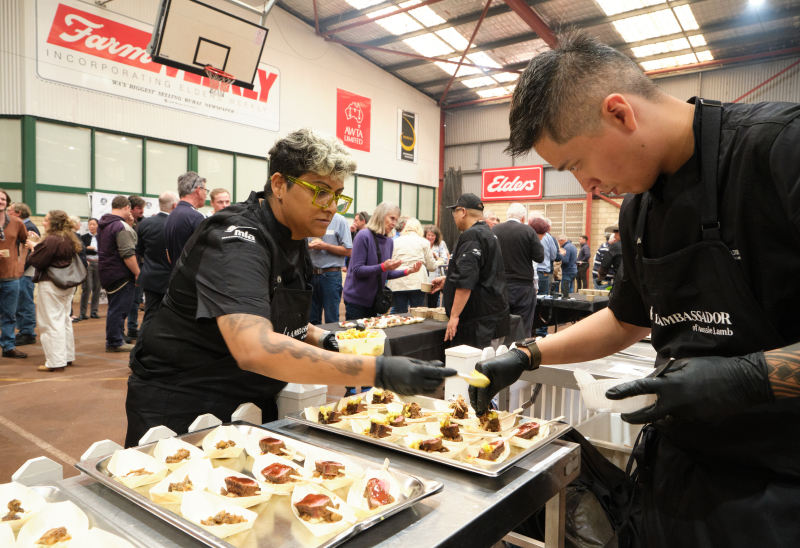
 Chef Beena plates up at the WAMMCO AGM
The Asian markets opening doors for Australian red meat
From Mumbai and Manila to Bangkok and Ho Chi Minh City, some of Asia's most influential chefs spent two weeks in October experiencing Australian lamb production firsthand.
The 23 chefs, representing 13 countries including Southeast and South Asia, took part in Meat & Livestock Australia’s (MLA) Lambassador program, an initiative designed to build advocacy for Australian lamb in some of the industry's fastest-growing export markets.
Travelling through Western Australia and Victoria, the delegation combined paddock visits, supply chain education and cooking demonstrations, helping chefs better understand the story and attributes behind the Australian lamb they serve in their restaurants back home.
India emerges as a market to watch
A major focus of this year's delegation was India, where improved market access has created new opportunities for Australian sheepmeat exporters.
MLA Regional Manager – South East Asia Valeska said trade had increased more than tenfold from a small base following the Australia-India Economic Cooperation and Trade Agreement (AI-ECTA).
“Trade's grown over 10 times off a very low base. I think there’s still room to grow,” she said.
Two prominent Mumbai chefs joined the program, reflecting the city's significance as a gateway for imported meat products.
“A lot of the imports that come into India, including Australian lamb, go into Mumbai, so I think that’s a perfect place to start,” Valeska said.
Among the delegation were Chef Altamsh from the Hilton Group and Chef Beena from Saltae Hospitality Group, providing MLA with connections across both premium hospitality and casual dining segments of the market.
The Indian component of the program also attracted support from the Australian Government, with chefs participating through a partnership involving DFAT and Austrade.
Following their return home, several chefs will participate in promotional activities linked to upcoming Australian trade visits.
Southeast Asia's growth story continues
Southeast Asia remains one of the fastest-growing regions for Australian red meat exports.
Valeska said changing consumer preferences were driving rising demand for safe, trusted and premium-quality proteins.
“Southeast Asia is the fastest growing region, with trade growing almost 9% on average annually,” she said.
This growth is also reflected in strong participation at major trade events such as THAIFEX and FHA, where Australian exporters continue to increase their presence.
Valeska said MLA’s presence at THAIFEX was continuing to grow, with the coordinated Australian pavilion set to more than double in size compared with previous years.
“It's only our second year at THAIFEX under the MLA-coordinated booths and we’re going to more than double our footprint,” she said.
Beyond attracting new customers, trade shows remain crucial for maintaining existing relationships and building connections with buyers from across the region.
Thailand shines as a premium lamb market
Among Southeast Asian markets, Thailand continues to stand out for Australian lamb.
While some neighbouring countries maintain significant demand for mutton, Thailand has developed into a predominantly lamb-focused market.
“Thailand is almost entirely a lamb market. I think it's because Thai consumers appreciate quality and appreciate brands,” Valeska said.
The country’s growing appetite for premium proteins has prompted MLA to double its in-market resources, supporting retailers, foodservice operators and education programs through initiatives such as the Aussie Meat Academy.
Valeska said strong country-of-origin branding remained critical as competition from other global suppliers intensified.
Opportunity growing in the Philippines
The Philippines is another market attracting increased attention.
Historically dominated by US product, the market is evolving as consumers seek a wider variety of proteins and Korean and Japanese food trends gain popularity.
Valeska believed Australian grassfed beef, grainfed beef, Wagyu and lamb all had opportunities to capture niche and premium segments.
“We want to try and debunk the myth that lamb may be difficult to cook or that it's not easy to find,” she said.
Supporting the campaign is Filipino chef, restaurateur and MLA Lambassador Chef Tatung. His substantial social media following and influence within the local food scene is helping connect Australian lamb producers with local audiences.
Football delivers a new platform for Aussie beef
Away from the kitchen, MLA continues to build awareness through an unconventional but increasingly successful channel: football.
Following the success of the Hyundai ASEAN Cup, attention has shifted to the regional Shopee Cup. The club competition runs through to May before making way for the Women’s Championship.
Valeska said the partnership platform was helping connect Australian beef with consumers through a shared culture of food, family and sport.
“We didn't realise how well sport and beef would come together,” she said.
“But in ASEAN, definitely the culture of football, the culture of togetherness and enjoying all the moments with Australian beef, I think that's the way to go.”
New campaigns will feature footballers alongside MLA's Aussie Beef Mates program, including digital content, retail promotions, foodservice activations and supermarket appearances across Thailand, Vietnam, Malaysia and Indonesia.
“We've got nutritionists involved, footballers involved, retail programs and foodservice activations under the banner of ‘Aussie meat, you run!’,” Valeska said.
For MLA, the strategy reflects a broader shift in how Australian beef and lamb are promoted across Asia.
Market access and trade remain critical foundations, but long-term success also depends on building cultural connections.
From chefs and restaurateurs to football stars, trusted local voices are helping Australian red meat connect with consumers across the region.