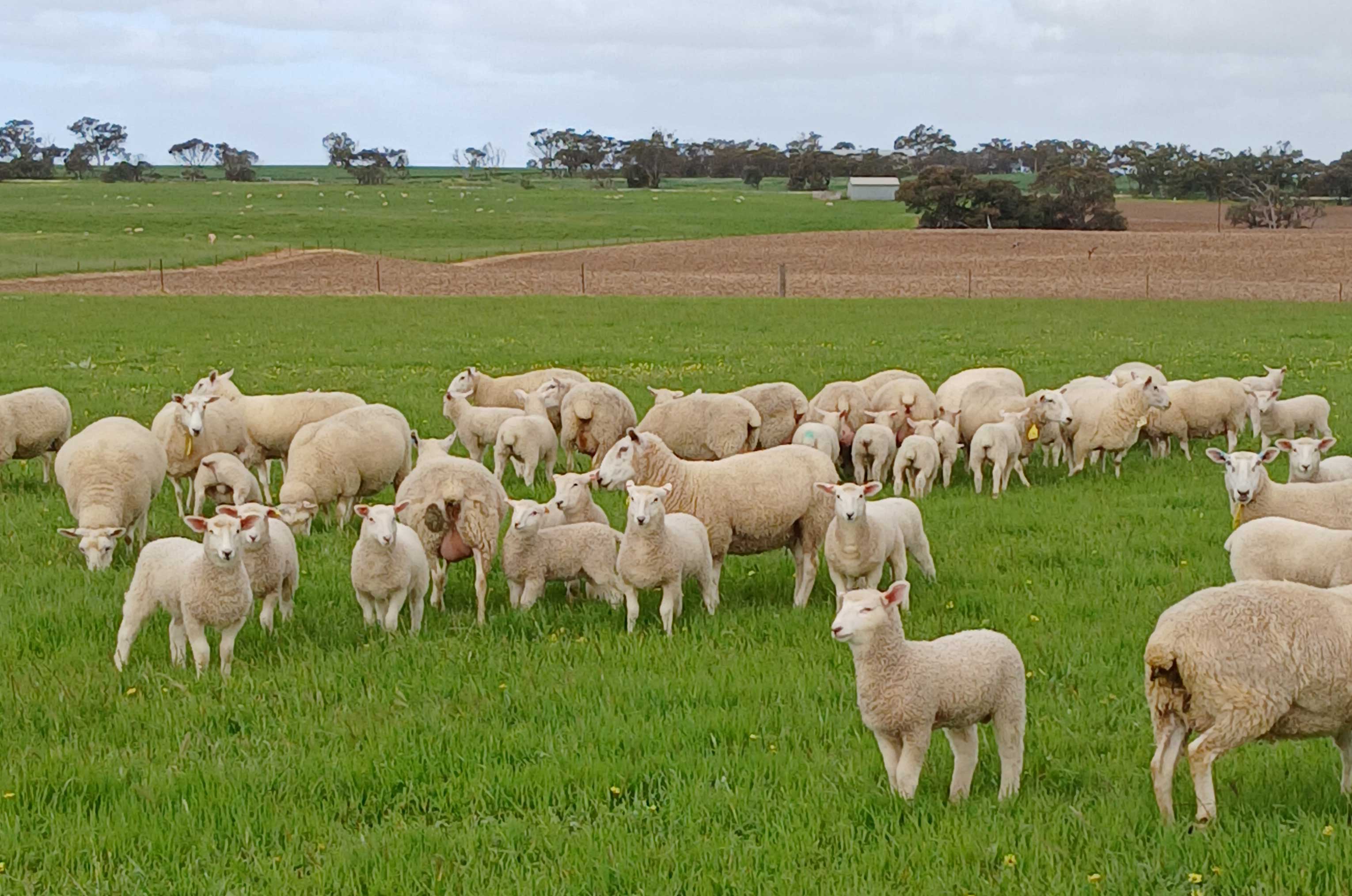
 Lynton Arney prioritises growth and reproduction in his Border Leicester stud at ‘Inverbrackie’. Image: Lynton Arney
How one breeding philosophy transformed a flock
For South Australian sheep producer Lynton Arney, learning how to track genetic data reshaped his breeding program.
Lynton and his wife Claire, with early help from their daughters Ellen and Lauren, own and operate Border Leicester stud ‘Inverbrackie’ at Strathalbyn, South Australia.
When Lynton was first offered the opportunity to take over the stud from his parents, Tom and Doreen Arney, he declined due to concerns about the industry’s perception of the Border Leicester breed.
His perspective changed in 1990 after learning about the genetic evaluation system LAMBPLAN, which helps producers improve flock productivity.
“It all made sense. If you can measure something you can actually make positive change,” Lynton said.
“So I went back and said I’d give it a go.
“We do our best to record everything we possibly can.”
Farm snapshot - Lynton and Claire Arney
-
NameInverbrackie
-
LocationStrathalbyn, SA
-
Area in hectares500ha
-
Enterprise typeBorder Leicester stud
-
Livestock type and numbers2,400 ewes and lambs
-
PasturesAnnual pastures
-
SoilsDuplex soils
-
Rainfall (mm)390mm
Tracking the right traits
Lynton said he relied heavily on Australian Sheep Breeding Values (ASBVs) to guide his breeding program and prioritised traits which would move more of his flock into the top 10% for genetic performance.
"We set the parameters each year using the percentile charts that come out of Sheep Genetics to work out what our threshold will be, what we're going to accept and what we're going to cull," he said.
In his stud, Lynton focused on growth and reproduction.
“You have to focus on the traits that are economic first,” he said.
“The first-cross ewe is the reason you have a Border Leicester.”
Getting the trends right
Through the Sheep Genetics program, Lynton can access his flock’s genetic trends across the past decade and compare them with breed averages.
He said all of his targeted ASBVs, except wool traits, have shown positive genetic trends.
At Inverbrackie from 2016 to 2025:
- Post-weaning weight (PWT) steadily increased from approximately 9.2kg to 12.6kg. By comparison, the breed average increased from 6.7kg to 10.2kg over the same period.
- Post-weaning fat depth (PFAT) increased from approximately 0.3 in 2016-17 to between 0.86 and 0.88 by 2024-25. Over a similar period, the breed average increased from -0.24 to +0.14.
Lynton said staying at the leading edge of genetic improvement has helped attract clients from more than 1,000km away.
“We need to make sure those major traits are heading in the right direction,” he said.
Under the microscope
Client feedback has also played an important role in shaping his breeding decisions.
When he first took over the stud, the Border Leicesters were long-legged. After listening to what clients wanted, Lynton shifted his focus to breeding shorter-legged, heavier sheep with increased fat and muscle depth.
"We listened to our clients on the results they're getting, and it drives us harder down the road of getting shape back into the carcases,” he said.
“We've got some pretty good clients and they keep putting us under the microscope.”
Adopting technology that helps
Lynton records every piece of flock data he can, including birth weight, weaning weight, fat and muscle scan results, lamb survival, fleece weight and wool measurements.
He recently started recording signs of entropion, a genetic defect in which the eyelid turns inward.
Rams also undergo four scrotal measurements. As Border Leicesters are seasonal breeders, Lynton is investigating whether seasonal variations in scrotal size could be linked to reduced breeding seasonality.
Sheep data is recorded using PedigreeMaster and the Arneys’ Tru-Test XR5000 weighing system, linked to electronic identification (eID) tags.
Lynton adopted eID technology in 2005 and now considers it his favourite piece of technology.
By the time a ram is sold at 15 months of age, nearly 30 pieces of information have been recorded for that animal.
Get involved in research projects
Lynton encouraged producers to put their hands up and get involved in research projects.
He recently participated in a three-month Optiweigh lease project with the Hills and Fleurieu Landscape Board.
Optiweigh is an automated in-paddock weighing system that sends weight data directly to producers, giving Lynton a clearer picture of what was happening in the paddock.
In one instance, daily weight updates indicated his flock wasn’t gaining weight as quickly as expected after being moved to a new paddock.
"I knew I had to find another paddock for them if I wanted them to keep growing at a good rate," he said.
"If I waited another month before bringing the sheep in to weigh them, it would possibly mean falling way behind."
Lynton also participated in an MLA Donor Company (MDC) project focused on measuring methane, with the aim to develop an ASBV for the trait.
He said he was excited by the potential for genetic selection to deliver a permanent and cumulative reduction in sheep methane emissions.
Perseverance is key
Sometimes making changes requires trial and error.
Lynton previously trialled out-of-season mating. Traditionally, his ewes were joined in February.
“I thought we were going really well the first year. We had more than 100 ewes out of 800 that got pregnant in November and I thought you beauty,” he said.
“So we mated the progeny, and any ewe that got in lamb out of season, the following year at the same time.
“No success this time.”
While the trial was worth attempting, Lynton said it was not something he intended to continue pursuing.
He noted one of the challenges is the time required to test small changes and wait for results.
"Sometimes you wonder if it is worth doing," he said.
"It's virtually got be habit to just keep collecting data when you've got sheep in.”
Don’t be afraid to ask for help
For producers looking to make changes, Lynton’s advice is to engage with experts.
"It's all to do with networking, and no one's told me to nick off yet,” he said.
If the advice is to make a change, Lynton said producers should act quickly because chances are the rest of industry will be looking for the same thing within a few years.
"It gives you time to filter it through the breeding program," he said.