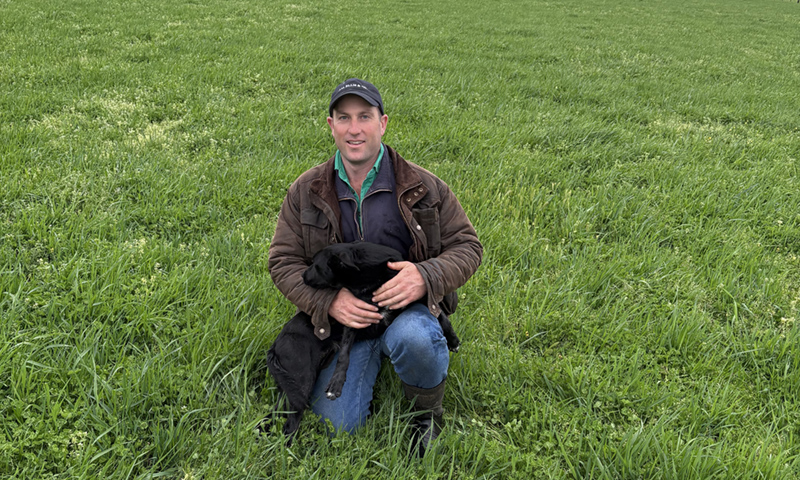
 Nick Baulch on-farm at Branxholme, Victoria where improved ewe lamb management is helping lift flock performance. Image supplied.
Better performance starts before breeding
For south-east Victorian producer Nick Baulch, improving the performance of ewe lambs has been less about pushing production and more about building consistency across his flock.
Nick runs 8,500 Highlander-composite ewes at Branxholme alongside his brother Charles, who manages the business partnership while working off-farm.
Nick is no stranger to joining ewe lambs, but had found the results varied significantly from year to year.
“Consistency was the biggest challenge,” he said.
“We could usually get them pregnant, but the results were all over the place depending on the season and the group.”
Historically, scanning rates ranged from about 106% to more than 150%, and their dry rates could be anywhere from 10–31%, depending on the year.
On average, the Baulchs’ system has been sitting around 130% scanning with 15% dry. Reducing that spread has become a key focus.
“That sort of variability makes it hard to plan,” Nick said.
“You want to know what those ewe lambs are going to deliver each season.”
Farm snapshot
-
NameCR & NP Baulch, ‘Audley’
-
LocationBranxholme, Victoria
-
Area in hectares1,200ha
-
Enterprise8,500 composite ewes, 200 Angus cattle
-
PasturesPredominantly phalaris and clover pastures, 150–200ha brassica forage crops
-
SoilsRolling volcanic clay loams
-
Rainfall~650mm
Raising the bar on joining weights
Nick became involved in MLA’s ‘More lambs from ewe lambs’ Producer Demonstration Site (PDS) after working with project lead Dr Jason Trompf on previous research.
It prompted Nick to reassess one of the key drivers of ewe lamb performance: joining weight.
Previously, he had been relatively flexible with the lower weight threshold for joining ewe lambs, aiming to maximise the number of animals contributing to the flock rebuild.
“We were probably a bit relaxed on that bottom end and letting the ram do the drafting for us,” he said.
“In the past we’d join ewe lambs from around 36kg.”
After reviewing the project research, Nick made an immediate change.
With mature ewes sitting at 65–70kg, he now aims to have ewe lambs reach around 65% of mature weight at joining, with continued growth through pregnancy.
“We lifted the cut-off weight straight away – first to about 38kg, and this year we’ve pushed that up to 40kg, with the aim of getting the average weight closer to 45kg before the rams go in.”
The shift means fewer lighter ewe lambs are joined, but Nick believes it will deliver better long-term outcomes.
“It takes those lighter animals out of the system,” he said.
“They often struggled to recover properly, and it affected their performance when they came back for their second joining.”
|
Lessons learned
|
Managing recovery
The timing of lambing and recovery is another critical consideration in Nick’s system.
His mixed-age ewes begin lambing in mid-July, while the ewe lambs start about a month later in mid-August.
To ensure the ewe lambs have time to recover before coming back into the main lambing cycle, lambs are weaned early at around eight weeks of age.
Ensuring adequate recovery time has been a key lesson.
“Getting them back around again can be just as much of a challenge as getting them pregnant the first time,” he said.
Start with best ewe lambs
Nick’s advice for other producers considering joining ewe lambs is simple: focus on the best animals first.
“Start with your top half,” he said.
“Don’t even worry about the bottom half initially. Do a really good job with your better ewe lambs and get them performing consistently.”
Once that group is performing well, producers can then look at gradually improving the remainder of the mob.
“If you try to push everything at once, it’s a lot harder to manage,” he said.
“Get the top end right first and lift the rest over time.”
Setting up for success
Beyond first lambing, Nick is focused on how ewe lambs transition into the main flock.
“We want those ewe lambs to go on and perform as two-tooths and beyond,” he said.
Management decisions, including early weaning and maintaining growth, are all geared toward ensuring ewe lambs recover well enough to rejoin successfully.
“The goal isn’t just getting them pregnant once,” he said.
“It’s about setting them up to be productive ewes long term.”
|
Seasonal action plan 1. Lift minimum joining weights 2. Prioritise recovery after lambing 3. Focus on the top-performing ewe lambs |
Data backs better system
By combining improved measurement, clearer targets and more structured management, Nick is building an ewe lamb program that delivers more predictable outcomes.
“Having those weight targets and tracking performance gives us a lot more confidence in what we’re doing,” he said.
As the PDS progresses, Nick expects further refinements to help optimise both productivity and survival.
“It’s about understanding what’s driving the results and making decisions off that,” he said.