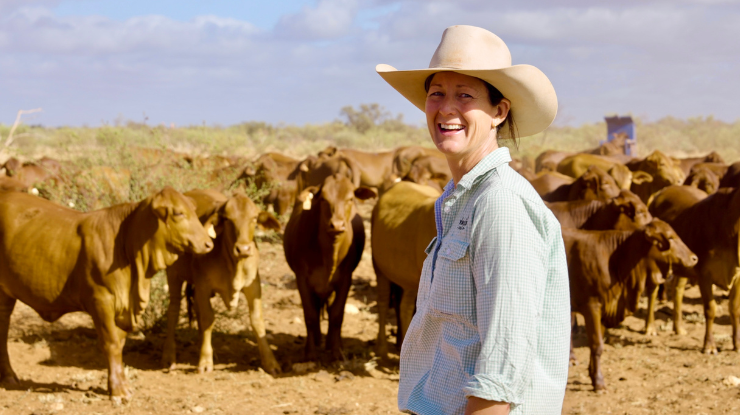
 Shanon Thompson (pictured) and her husband Clint own and manage 'Wyloo Station'.
Rest-based grazing lifts herd and pasture performance
Managing grazing pressure is an essential part of pastoral businesses across the west Pilbara region of WA – here’s how it’s being used on one station to improve breeder and pasture performance.
Through the Pilbara Extension Network (PEN), the team at ‘Wyloo Station’ in the Ashburton River region is exploring how a rest-based grazing system can improve the management of heifers and second calvers while ensuring optimal pasture availability and improved land condition.
Rest-based grazing systems centre on allowing the country time to recover between grazing events.
Instead of cattle remaining in the same paddock for extended periods, livestock are moved so plants can regrow, rebuild root reserves and set seed before being grazed again.
Farm Snapshot
-
Shanon Thompson“Wyloo Station”, Ashburton River region (west Pilbara), WA
-
Area200,000ha
-
EnterpriseDroughtmaster cattle
-
PasturesNative perennial grasses and spinifex systems
-
SoilsOpen plains, rocky ridges, alluvial river flats
-
Rainfall280mm (highly variable)
In rangeland environments where vegetation can respond quickly to rainfall but decline rapidly under sustained grazing pressure, these recovery periods play an important role in maintaining pasture condition and ground cover across the landscape.
How it works at Wyloo
The system being tested at Wyloo centres around a five-paddock grazing structure designed to move cattle through paddocks in a planned sequence while providing defined rest periods for pasture recovery.
This project was implemented within the $60,000 budget allocated through PEN.
Location: The first stage of the project involved identifying and surveying the areas considered most suitable for the system. Once these areas were selected, infrastructure work began to support the grazing design.
Fencing: Strategic fencing was installed to create the five paddocks. Several water points were upgraded to ensure adequate water supply and enable cattle to utilise paddocks more evenly across the system.
Technology: Monitoring sites were established using the Gascoyne Pilbara Rangelands Initiative Rangelands Monitoring Tool to track pasture condition and land health indicators over time. An Optiweigh unit was also installed to provide real-time information on animal performance.
Controlled mating strengthens herd
A key component of the system is the continuation of controlled mating for specific classes of cattle, particularly heifers.
Managing these heifers separately allows Wyloo’s management team to make strategic decisions as the season progresses.
The first cohort of 210 heifers was inducted into the system in March 2025. They weighed an average of 390kg. Seven bulls were joined to the heifer group for a 60-day mating period.
Monitoring to manage
Monitoring how cattle respond to the grazing system is another important component of the project.
Wyloo Station is incorporating Optiweigh technology – a fully portable weigh system used in the paddock. Animals are enticed into the unit using an attractant which allows cattle weights to be recorded automatically.
Optiweigh data provides real-time information on animal performance, without the need for animals to be yarded.
Importantly, the technology is not being used in isolation, but as one tool to help make management decisions. Animal liveweight data is cross-referenced with paddock observations and pasture monitoring to understand how cattle performance is responding to pasture availability across the system, as well as how the pasture itself is responding to grazing and rest.
Round she goes
Once inducted into the system, the mob of heifers move through the five paddocks in sequence.
Movement decisions are based on a combination of paddock observations, pasture monitoring data and Optiweigh information.
This combination of observations and weight data allows the station team to assess how well the grazing system is supporting both animal performance and pasture recovery.
Where necessary, carrying capacity can be adjusted by shifting or selling preg-tested empty (PTE) heifers to ensure grazing pressure remains appropriate for the available feed.
Building data into decisions
Another aspect of the project is the opportunity to collect more detailed reproductive performance data across the herd.
With tighter mating periods and clearly defined cohorts, the station team can identify animals which may not be performing as well reproductively and make more informed decisions about which females remain within the breeding herd.
Practical insights for others
In a region where rainfall, pasture growth and cattle performance can vary widely from season to season, management systems that allow both livestock and country to respond to these conditions are increasingly important.
The work underway at Wyloo Station is helping build practical knowledge around how grazing systems in the Pilbara might continue to evolve while maintaining productive and resilient rangelands.
By combining rest-based grazing, controlled mating, infrastructure development and performance monitoring, the project is exploring how these tools can work together to improve the management of heifers and second calvers while supporting pasture recovery.
This PEN project has also opened pathways to further research, with a new project underway at Wyloo in conjunction with Dr Kelsey Pool that investigates the impacts of heat stress on cattle health, productivity and reproductive performance.
Lessons learned
|
Producers leading changeAn 18-month pilot in the Pilbara, WA, is proving what’s possible when producers lead the way in research and development. The Pilbara Extension Network (PEN), delivered through the Pilbara Innovation Partnership (PIP), supports seven pastoral stations to design, deliver and evaluate projects that matter to their business. Each station nominates a project lead who shapes a project around a challenge specific to their operation, which can generate insights to benefit the northern beef industry in the long-term. Wyloo Station is one of the businesses involved in the initiative. Round Two of PEN has begun, with expressions of interest submitted and candidate vetting now underway. The collaboration between PIP, funding partners WA Department of Primary Industries and Regional Development, MLA, Rio Tinto and producers ensures investment flows into locally identified priorities, aligning people, skills and leadership with improved landscape conditions and long-term productive capacity. |