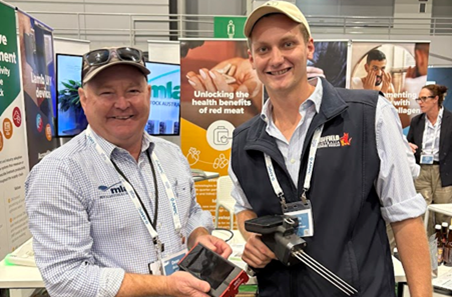
 MLA’s Objective Measurement and Data Adoption Manager, Dean Gutzke (left) and Cailan Byrnes holding the MEQ Probe at the AMPC Innovation Showcase in September 2025. Image: Cailan Byrnes
Tech is key to small business barriers
Calian Byrnes’ 2025 MLA-support Nuffield Australia Scholarship journey has taken him around the world in search of a solution to break down the barriers for small businesses to implement the latest beef grading eating quality technology.
The cost and resourcing challenges required to meet accreditation standards mean the objective measurement (OM) technology currently being used by larger industry players is largely out of reach for many small businesses like his own, particularly in northern Australia.
Challenges for small businesses
Improving access to this game-changing technology will deliver positive flow-on effects to Cailan’s third generation family business, Byrnes Meats, and the 50 local producers who supply their cattle into its Rocky Creek Abattoir.
Cailan hopes to work with industry to expand the use of OM technology by making it easier to use and less reliant on heavy staffing and training requirements.
“The main hurdle for smaller, family-run businesses like mine is to overcome the cost of not only buying the technology, but having the infrastructure and staffing to maintain it and keep your certification,” Cailan said.
“If we can get to the point where an objective measurement camera alone can accurately assess the meat it will be more scalable and cost effective for smaller businesses.
“Currently the technology must be used by a trained grader and the staff training required to be an accredited grader is quite extensive.
“Each grader must be trained, approved and retrained to stay current,” he said.
Cailan hopes that within three years the technology will advance to the point where accreditation will be more accessible.
“It will be game changing for the little plants like ourselves,” he said.
International excellence
As part of his Nuffield Scholarship, Cailan wanted to find examples of businesses that had successfully implemented technology, without it slowing down production speed.
He visited Denmark and met with Frontmatec, a technology company that developed the handheld Q-FOM™ meat grading camera. He also toured seed processing and blueberry packaging factories in Chile, where he was impressed by their top-notch organisation of systems and staff.
“It’s all well and good to have the technology but it’s no use if it slows down production speed,” Cailan said.
“You also need to make sure the technology is certified and accurate – if it predicts the meat is going to be a certain colour, then it’s going to need to actually be that colour.”
Nuffield provides opportunities
A common sentiment expressed by Nuffield scholars is the role the scholarship plays in getting them to step out of their comfort zone.
“It enables people to have an idea, develop their passion and have the chance to go out there and explore how it might change industry – you can explore big picture thinking,” Cailan said
“Nuffield gives an opportunity to people who would not normally have the chance to be involved in this sort of experience. It gives producers on-the-ground a voice and the chance to give back to industry.”