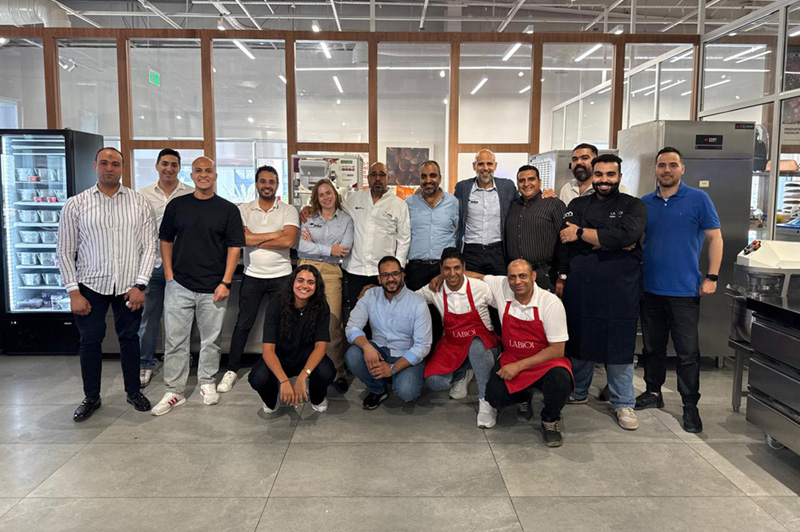
 Egypt Aussie Meat Academy participants
Market stabilisation strengthens opportunities for Aussie red meat
Darren Watson, Meat & Livestock Australia’s (MLA) Regional Manager for Europe, the Middle East and Africa, shares a practical update on market conditions across his region.
There is a clear theme emerging – conditions are improving, but recovery will take time.
Middle East: Early signs of improvement
Recent geopolitical developments in the Middle East are starting to shift sentiment in a positive direction. Agreements around a cessation of conflict and updated travel advisories are helping rebuild confidence, though Darren cautioned that recovery won’t be immediate.
“There’s definitely positive movement, but it’s not a switch that flips overnight,” he said. “We’re looking at anywhere from 9–12 weeks before we start to see more normal conditions return.”
Logistics across the region remain challenging with shipping remaining the greatest hurdle as without ‘assurance’, there is no ‘insurance’. Supply is still down year-on-year following several months of constrained availability. Chilled products have been more impacted than frozen, reflecting the broader disruption across supply chains.
Air freight is one area showing improvement. The United Arab Emirates (UAE), particularly Dubai, has remained a key hub, with increased activity over recent months. As travel advisories ease across major markets, including the United Kingdom (UK), United States (US) and Australia, airlines are expected to return more capacity into the region.
However, Darren noted that infrastructure alone won’t drive recovery. Consumer and tourism confidence will be critical.
Tourism and demand still rebuilding
Hotel occupancy rates remain low, currently sitting in the low double digits. This is continuing to impact demand across the broader supply chain, including foodservice and imported products.
Currently, travel is largely coming from nearby regions, alongside markets such as Russia and China. Western markets are only starting to return following recent advisory changes.
“There are early signs of improvement, but it’s still very early in the recovery cycle,” Darren said.
Looking ahead, industry events such as Gulfood (March 2027) are expected to play an important role in reconnecting customers and driving momentum.
“There’s likely to be strong interest this year as businesses look to recover lost ground and re-engage,” he said.
Saudi Arabia: Re-engaging the market
With regional travel still somewhat restricted, activity in Saudi Arabia has focused on in-market engagement.
MLA’s local team recently delivered a culinary immersion event targeting top chefs and foodservice professionals. The program, delivered through the Australian Meat Academy and ambassador initiatives, aimed to reconnect the industry with Australian product.
Led by MLA’s Corporate Master Chef Tariq Ibrahim, the two-day program focused on product utilisation and capability building.
“It’s about re-engaging the culinary community and reinforcing what we can offer, even in the current environment,” Darren said.
UK market: Structural opportunity
In contrast to the Middle East, the UK market is being shaped by longer-term structural changes. Domestic beef production has been in steady decline over the past 20 years, creating opportunities for imported product.
“For Australia, we’re complementary to UK production,” Darren said.
“Even current export volumes are well below the quotas under the UK-Australia Free Trade Agreement.”
Demand for imported beef and lamb remains strong, supported by increased awareness and understanding of Australian product. MLA’s messaging around quality, traceability, food safety and animal welfare continues to resonate.
Building awareness through engagement
The MLA team in the UK and Europe is focused on strengthening relationships across the supply chain – from importers and distributors through to chefs and media.
Recent activity has included Aussie Beef and Lamb Summer BBQ events designed to showcase product and bring industry stakeholders together.
In addition, technical engagement through butchery masterclasses and live cooking demonstrations is proving effective, particularly in highlighting value, utilisation across different cuts and margin maximisation.
Brisket demand on the rise
One notable trend in the UK is the growing demand for brisket, particularly Wagyu.
“The brisket category is really gaining traction here. Australian grainfed Wagyu brisket is fitting well into that trend,” Darren said.
Through masterclasses and live demonstrations, MLA is helping chefs and buyers understand how to maximise carcass value and incorporate Australian product into menus.
This trend was evident at recent industry events such as Taste of London, where Australian brisket featured prominently in live cooking formats.
“It’s encouraging to see that level of interest, particularly from emerging chefs coming through,” Darren said.
Cost pressures and consumer behaviour
Like many markets, the UK is facing ongoing cost-of-living pressures. Rising input costs across energy, fuel and agriculture are flowing through the supply chain.
Despite this, Darren noted that demand remains relatively resilient.
“There is some caution around spending, but consumers are still prioritising social occasions and food experiences,” he said.
Favourable weather has also supported foodservice demand, with more consumers dining out and gathering socially.
Foodservice continues to be a priority channel for growth in the UK.
Tight global supply – particularly from the US – and declining domestic production are creating opportunities for Australian grain-fed beef to fill market gaps.
“Australia has a strong story to tell. It’s about continuing to communicate that effectively and meeting market needs,” Darren said.
Looking ahead
While challenges remain, the overall outlook across the region is improving.
Supply chains are stabilising, travel is beginning to return and demand is gradually rebuilding. At the same time, structural opportunities, particularly in the UK, continue to strengthen Australia’s market position.
“There’s always work to do, but we’re heading in the right direction,” Darren said.